Corning GlassBridge ™: A New Generation Optical Platform Connecting Optical Fibers and Photonic Chips

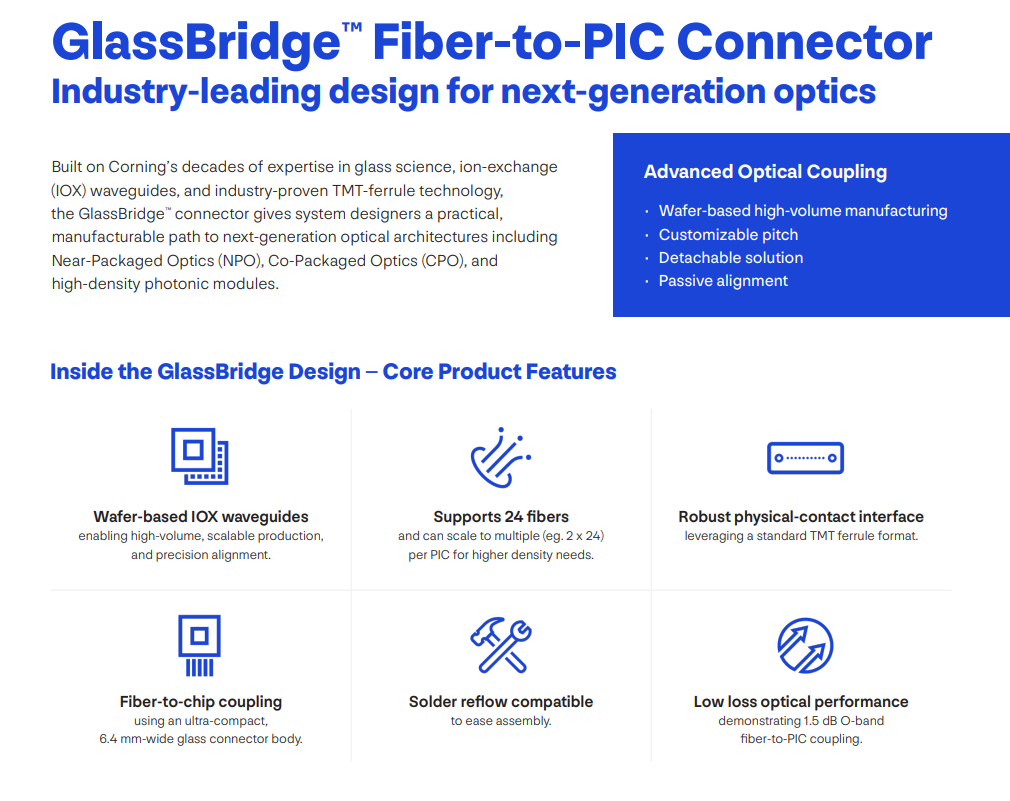
GlassBridge ™ It is a wafer level fiber photonic integrated circuit (PIC) connection technology platform developed by Corning based on decades of experience in glass science and precision manufacturing. It is designed to support scalable manufacturing, robust physical contact interfaces compatible with standard TMT plugs, and detachable high channel connections.
As part of a broader connector system architecture, GlassBridge serves as both a precision glass component and a complete connector assembly, providing system designers with a practical and manufacturable path to the next generation of optical architectures, including near packaged optics (NPO), co packaged optics (CPO), and high-density photonic modules.

Core features of GlassBridge ™
Wafer level ion exchange (IOX) waveguide: supports large-scale, scalable production, and achieves precise alignment.
Ultra compact fiber chip coupling: using a glass connector body that is only 6.4mm wide.
High channel density: A single connector supports 24 optical fibers and can be expanded to multiple per PIC (such as 2×24) to meet higher density requirements.
Reflow soldering compatibility: easy to assemble and integrate.
Low loss optical performance: The coupling loss from O-band fiber to PIC is as low as 1.5dB.
Customizable spacing: supports multiple PIC spacing configurations.
Passive alignment: Efficient assembly can be achieved without active adjustment.
Standard TMT plug: Adopting the standard TMT plug format with a 125 μ m aperture to ensure the reliability of the physical contact interface.
Significant advantages of GlassBridge ™ in system:
Scalable Manufacturing: Wafer level design supports mass production.
Customizable spacing: Supports multiple PIC spacings (such as 40 μ m, 80 μ m, 127 μ m, 165 μ m) to achieve higher coastline density, and can be converted according to application requirements.
Detachable connector: Provides flexible deployment and maintenance solutions for on-site service.
Passive alignment: Efficient assembly, significant cost savings.
Standardized TMT plug: Using a physical contact interface with a standard TMT plug (125 μ m aperture) to ensure reliability and ease of use.
High channel count: A single connector can support over 24 channels, meeting the requirements of advanced systems.
How does it work?
GlassBridge ™ It is a modular connector platform designed specifically for expandable optical systems, and its working principle can be divided into three levels:
- Wafer level design enables mass production
The core of the platform is GlassBridge components, produced using wafer level manufacturing processes. This supports scalable production and consistent optical integration, achieving efficient assembly and cost-effective manufacturing through passive alignment.
- Standardize TMT physical contact interface to achieve seamless ecosystem integration GlassBridge ™ The connector is connected through a sturdy and reusable physical contact design, utilizing standard TMT plugs. By building upon widely adopted TMT technology, this platform can integrate more naturally into existing optical ecosystems while supporting reliable and maintainable connections.
- Removable, high-density fiber PIC connector architecture GlassBridge ™ Designed as a detachable connector platform, it supports over 24 optical channels in a compact form factor and features customizable spacing configurations to meet different system and PIC requirements. This architecture provides flexibility during assembly, testing, and system integration while maintaining the density required for modern optical systems.
Future oriented NPO and CPO architectures
GlassBridge ™ Specially designed to support the next generation of optical architectures:
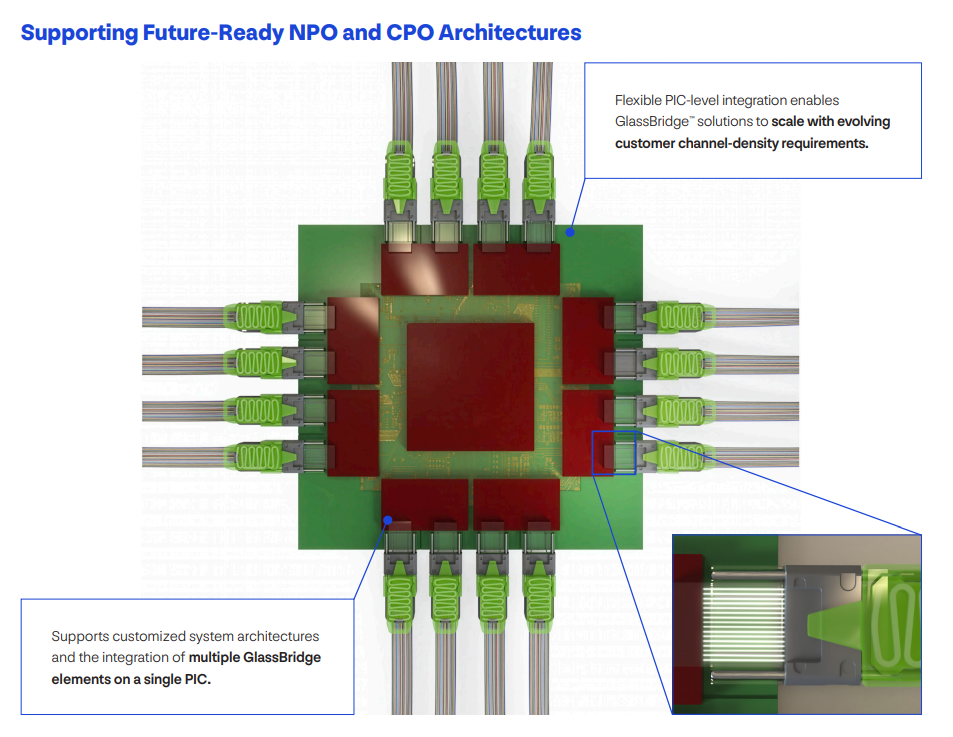
Flexible PIC level integration: enables the GlassBridge solution to scale as customer channel density requirements evolve.
Multi connector integration: Supports customized system architecture and can integrate multiple GlassBridge connectors on a single PIC.
Application scenarios: Provides system designers with a practical and manufacturable path to the next generation of optical architectures, including near packaged optics (NPO), co packaged optics (CPO), and high-density photonic modules.