Starlink’s Urban Growth Exceeding Rural with 13.6 Million Global Users

According to Ookla’s latest Speedtest report, Starlink’s broadband speed has improved comprehensively, and customers in urban areas are also growing. Ookla stated that Starlink customers are moving out of rural areas in the United States. In the first half of 2026, the number of Starlink Speedtest urban users increased by 73% year-on-year, which is more than twice the growth rate of 33% in rural areas. Ookla editorial director Sue Marek stated that in the first half of 2026, urban users in every state except Alaska and Hawaii will grow faster than rural users; Part of the reason may be Starlink’s promotional activities. She said that many people believe that Starlink is only targeted at rural users, but the data shows otherwise.
Upload speed increased by 42%
In terms of performance, Marek pointed out in the report that the median upload speed in the United States increased by 42% year-on-year, from 14.63 Mbps to 20.73 Mbps, and improved in all 50 states and Washington D.C. She said that this improvement may be attributed to SpaceX’s new V2 Mini satellite, which has significantly higher capacity than earlier models. According to the report, as of early October, SpaceX has launched approximately 7550 V2 Mini satellites for broadband services, with data sourced from Harvard astronomer Jonathan McDowell’s Starlink tracker. According to McDowell’s website, V2 Mini accounts for approximately two-thirds of Starlink’s operational satellites. Delay has also improved in 49 states and Washington D.C., with the number of states experiencing delays below 40 milliseconds more than doubling.
About 90% of new users come from non fiber optic access
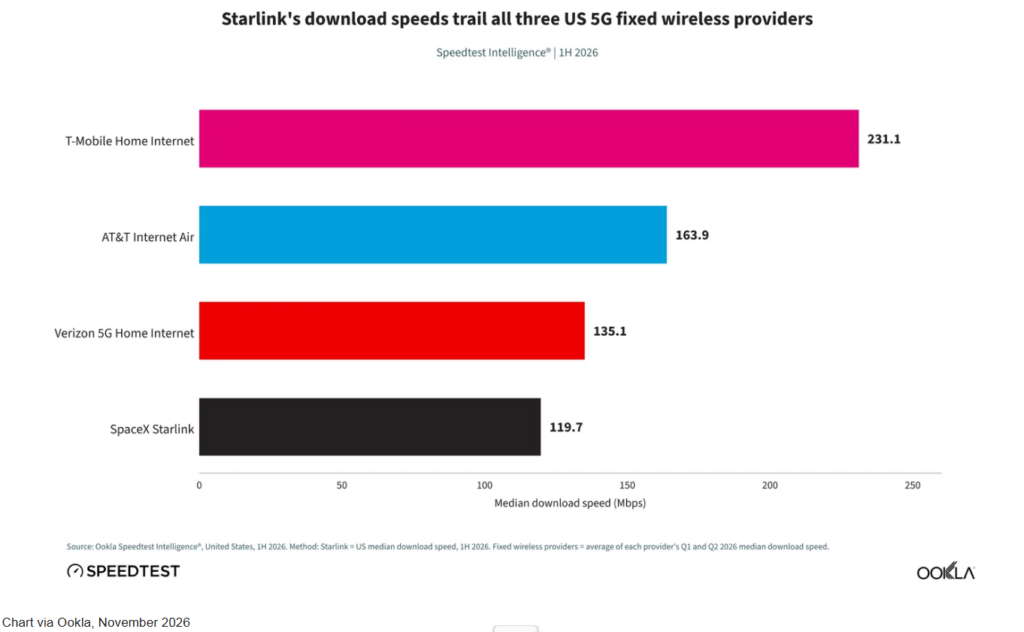
According to reports, Starlink launched a series of promotional activities in 2026, which Marek believes may be one of the reasons for customer growth. The company offers prices ranging from $29 to $39 per month in certain regions of the United States. But the growth of urban users also comes from customers shifting from non fiber optic connections to Starlink, such as cable, DSL, and fixed wireless access (FWA). More specifically, about 90% of new users have switched from these access technologies to Starlink. Marek stated that this means traditional broadband providers are losing customers to Starlink. However, despite improvements in satellite and beamforming technology, Starlink’s median download speed is still slower than the three major 5G FWA providers in the United States. Marek wrote in the report that the gap may be related to geographical location, as the orbit angle of Starlink satellites concentrates coverage in the mid latitudes of the northern hemisphere, so users further south typically have fewer satellites overhead at any given time and less shareable capacity.
SpaceX: Starlink has 13.6 million global users
SpaceX reported during its quarterly earnings call at the end of October that Starlink saw a net increase of 1.6 million global broadband consumer users in the third quarter. Overall, Starlink has 13.6 million broadband consumer users in 174 markets. According to Ookla Speedtest data, approximately 22% of Starlink’s customers are in the United States, which is the company’s largest market. SpaceX announced during its earnings call that it plans to continue adding capacity to the Starlink low Earth orbit satellite constellation through the new V3 constellation. SpaceX CEO Elon Musk said that SpaceX is at a turning point in launch connectivity; The 14th flight of Starship is a key milestone, as it entered orbit for the first time and deployed operational Starlink V3 satellites. The 14th flight deployed a Starlink bandwidth of 26 terabits per second, equivalent to 10 Falcon 9 launches. Musk said that one Starship launch – not even fully loaded, only about half loaded – completed the equivalent of 10 Falcon 9 launches. He predicts that within three years, the bandwidth of the Starlink constellation may reach about 100 times its current level.