Corning’s Multicore Fiber Solution Breaks Density Bottleneck

The development of AI is transforming the physical architecture of data center networks.
For a long time, network expansion primarily relied on continuously increasing various infrastructure components: deploying more fiber optics, adding more connectors, installing more distribution panels, and extending more wiring pathways. When bandwidth demand grew steadily, this model was still applicable. However, when bandwidth demand surges exponentially and deployment density approaches physical limits, the traditional approach of scaling up hardware for expansion becomes obsolete—this is precisely the challenge that GPU-driven AI development is gradually facing.
As AI training clusters continue to expand, the bottleneck in network expansion is no longer the transmission speed of light in optical fibers, but rather the total capacity of infrastructure supported by racks, trays, and conduits. The deployment space of networks is facing severe challenges.
This is precisely the challenge that Corning® Multicore Fiber Solution aims to address: achieving a leap in deployment density without increasing the size of wiring equipment. As the first company to invent low-loss fiber, Corning continues to innovate and tackle the challenges currently faced by customers.
Greater capacity, simpler architecture
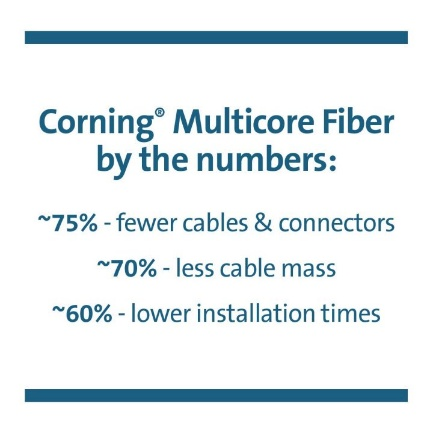
Key Data for Corning® Multicore Fiber:
The number of cables and connectors has been reduced by approximately 75%
The total weight of the cables is reduced by approximately 70%
Installation time is reduced by approximately 60%
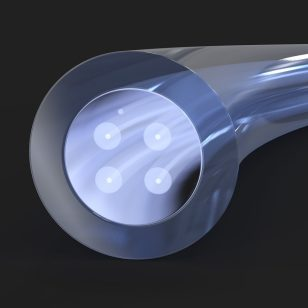
The 4-core multicore fiber showcased at the 2026 Optical Fiber Communication Conference and Exhibition (OFC) integrates multiple independent data channels into a single fiber without increasing the outer diameter, effectively enhancing network capacity. In some practical deployments, its transmission capacity can reach four times that of conventional single-core fibers within the same space.
This is not merely an enhancement at the theoretical level. Multicore fiber can reduce the number of cables laid in trays and the number of connectors at the top of racks, saving valuable space. With multicore fiber, network capacity is effectively expanded while physical complexity decreases.
Why Can Density Change Everything
Density not only pertains to space occupancy but also directly impacts operational efficiency.
Every additional cable introduces extra weight, labor input, risks, and time consumption. Each connector may become a potential point of failure. As network deployment density continues to rise, installation progress is hindered, troubleshooting becomes more difficult, and the business go-live cycle is prolonged.
Multi-core fiber has reversed this trend. By increasing the capacity of a single fiber, it effectively reduces the number of physical components required for network construction, achieving a more streamlined architecture, more efficient deployment, and lower operational complexity—advantages that continue to grow as the network expands.
In large-scale AI environments, this technology can free up more rack space, alleviate wiring path congestion, and enhance network switching and computing capacity without expanding the data center footprint.
Deployment speed is crucial to strategic advantage
One of the most strategically valuable impacts of multi-core fiber optics is deployment efficiency.
With the help of multi-core fiber technology, the number of cables and connectors has been significantly reduced. In some actual deployments, installation time can be shortened by about 60%, and network deployment speed has been greatly improved – compared to traditional single core fiber, deployment cycles can even be advanced by several months. For AI data center operators deploying large-scale GPU clusters, time is the benefit. For every month of early completion, the added computing power can be put into commercial monetization one month earlier.
From this perspective, multi-core fiber optic is not only an infrastructure upgrade, but also a key solution to shorten the construction period and reduce deployment risks in scenarios with high delay costs.
The ecosystem is getting ready
The multi-core fiber optic ecosystem is accelerating its maturity. Manufacturing, installation, testing, and other aspects are all coordinated around actual deployment and application, and Corning plays a key role in promoting the popularization and application of the industry.
Recently, Corning, together with three other industry leaders, signed a Multi Source Agreement (MSA) to focus on passive optical connectivity in data centers, clarifying the core design specifications, performance indicators, and interoperability requirements for 4-core multi-core fiber optic cables (i.e. SDM4 MCF). The purpose of this cooperation is to unify operational procedures, scope of application, and technical standards, promote the large-scale application of multi-core optical fibers, and lay the foundation and accelerate the development of the new generation of global technology and information standards.
Thanks to the increasingly mature multi-core fiber ecosystem, multi-core fiber is no longer in the conceptual discussion stage, and technology, supporting tools, and market demand are accelerating their integration.
Building the cornerstone of future development
Multi core fiber is not a one-time optimization solution, but a structural change in the expansion of optical networks.
Corning’s multi-core fiber achieves high-density deployment within standard specifications, laying a solid foundation for future oriented AI networks. As bandwidth demand continues to rise, multi-core architectures can support subsequent technological innovations without the need for disruptive changes to existing physical infrastructure.
In summary, AI not only drives the high-speed development of networks, but also forces them to evolve towards higher density, simpler architecture, and higher efficiency. And multi-core optical fibers have responded positively to this development demand.