GSA: Global 5G User Report Released

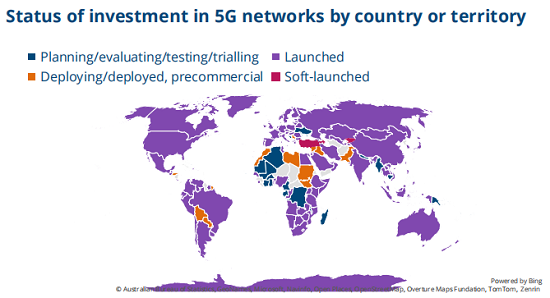
According to data released in a webinar hosted by the Global Mobile Suppliers Association (GSA) in December 2025, the 5G market has continued to develop over the past year, evolving from its initial deployment phase in 2019 to become a cornerstone of the digital economy. GSA statistics show that 647 operators across 191 countries and regions worldwide are investing in 5G technology.
Among them, 384 operators have launched one or more 5G services compliant with 3GPP standards, while 358 operators have introduced 5G mobile services. Currently, the focus of 5G development is shifting from extensive network coverage to enhancing advanced capabilities, with 5G standalone (SA) and 5G-Advanced (5G-A) technologies empowering new applications across various industries. In 5G devices, mobile phones account for over half, followed by modules (10%).
Deployment Progress of 5G SA and 5G-Advanced
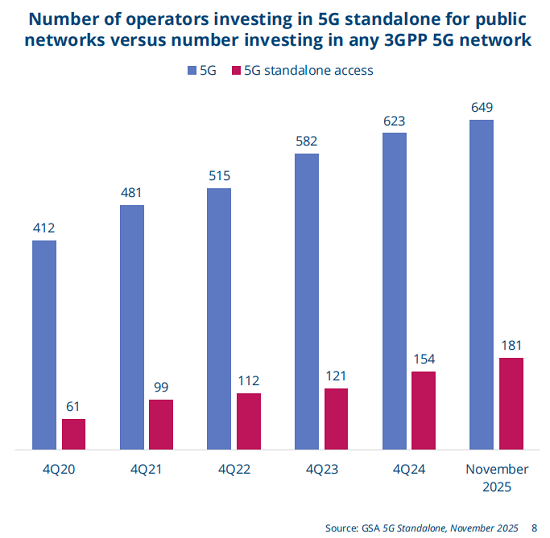
In terms of 5G standalone (SA) networking, the GSMA has confirmed that 181 operators across 73 countries and regions worldwide are investing in public 5G SA networks. It is reported that at least 85 operators in 47 countries and regions have already launched public 5G SA networks, while an additional five operators are in the process of deploying 5G SA networks.
As for the more advanced 5G-Advanced technology, as of November 2025, only seven operators have launched 5G-Advanced networks. Among those investing in 5G-Advanced, over 50% are currently in the technical testing phase. Asia leads in this field: operators in India, Uzbekistan, and Taiwan, China are investing, while Chinese Mainland, Macau, China, and Malaysia have already introduced 5G-Advanced services.
5G RedCap and FWA Service Area Dynamics
In terms of regional deployment of 5G RedCap technology, the adoption speed in the Asia Pacific region remains the fastest in the world. In the Americas region, the United States has deployed and Canada is in the testing phase; A Latin American operator (TIM Brasil) is planning to launch RedCap services. In the Middle East, most operators are in the testing phase, and very few have already launched or plan to launch 5G RedCap services. In the European region, 7 operators are currently testing and 4 have plans to deploy RedCap. There are no relevant plans in the African region in the near future.
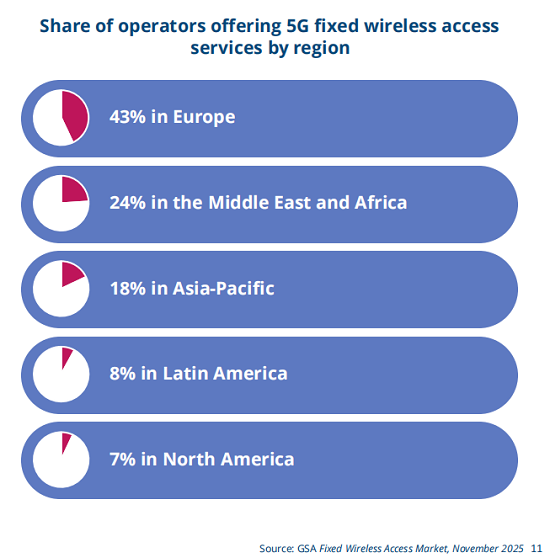
In terms of 5G fixed wireless access (FWA) services, nearly half of the services are provided by European operators. There are currently 352 indoor and outdoor 5G customer terminal device models on the market, with indoor models accounting for 60%, proving to be a more popular choice. There are currently six different operators providing 5G FWA services in Slovakia.
Private networks, satellite communication, and 2G/3G network withdrawal trends
In the field of private mobile networks, most deployments are still using LTE technology, but the share of 5G networks is increasing. Among the customer cases collected by GSA, 48% are currently deploying 5G private networks, with 5G mainly used for long-term trials or deployments in educational facilities.
In terms of satellite direct mobile phone services, 14 operators have launched this service in countries such as Australia, Canada, and the United States. AST SpaceMobile has publicly announced 27 partnerships in Africa, Asia Pacific, Europe, and North America, although its commercial services have not yet been launched.
Regarding the retirement of 2G and 3G networks, it is expected that the shutdown speed of 3G networks will exceed that of 2G after 2026. 2025 is the peak year for planned retirement, with 37 operators planning to gradually phase out 2G networks and 39 planning to shut down 3G networks. More than half of the operators planning to shut down their 2G and 3G networks plan to upgrade to both LTE and 5G networks simultaneously.
Overall, mobile operators continue to invest in 5G connectivity technology in many countries around the world to meet diverse application needs. GSA expects that the evolution of 5G technology, including 5G standalone networking, 5G Advanced, and 5G RedCap, will continue to develop in 2026 and beyond.