LC: Cloud Companies’ Capital Expenditures Surge, Market Risks Intensify

LightCounting recently released a research report analyzing the impact of the surge in cloud companies spending on the optical communication market based on preliminary financial performance for the fourth quarter of 2025. The report points out that the expenditure of cloud companies and the sales growth of Ethernet optical transceivers and DWDM transmission equipment continue to exceed expectations. Although some suppliers have expressed a surge in demand and have “excellent visibility” for 2026 and even 2027 due to customers signing long-term supply agreements, LightCounting believes that this visibility in 2027 and beyond is questionable, and having a “Plan B” is more crucial than ever before.
The capital expenditure competition among cloud companies is intensifying
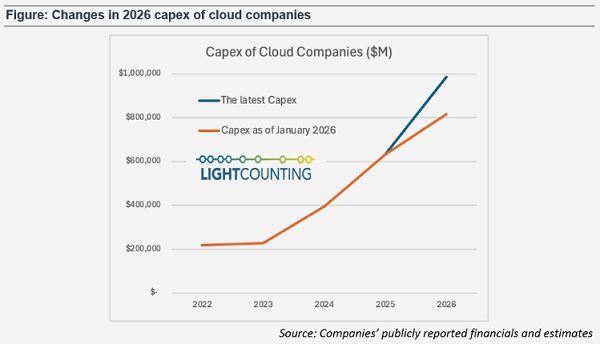
The following chart shows the expenditure growth of cloud companies and the changes in market expectations for 2026 over the past two weeks. By 2025, the top five cloud companies (Amazon, Google, Meta, Microsoft, and Oracle) will account for 68% of the industry’s total capital expenditures, and all of these companies plan to almost double their expenditures by 2026. This is clearly a competition: if one player accelerates, other players must keep up. It is worth noting that the capital expenditure growth rates of these five “contestants” have maintained astonishing consistency.
Historical Warning and Market Risk
The report points out that cloud companies are supporting their massive expenditures through borrowing. Google has issued 100 year bonds, which has never been seen since the telecom foam at the end of the last century. LightCounting expresses the hope that history will not repeat itself, but will always be astonishingly similar. Even if one of the top five cloud companies experiences a moderate decrease in spending, it could trigger a chain reaction throughout the industry’s supply chain. Although it is impossible to predict the timing of such events, LightCounting’s latest forecast still leans towards a “soft landing” scenario, but the recent surge in capital expenditures suggests that there will be more turbulence in the future.
Supply chain is fully loaded, investment is shifting towards infrastructure
LightCounting is expected to increase its forecast for 2026 in the reports released in March and April, but the changes will not be significant. At present, the industry supply chain is operating at full capacity. Investing an additional $170 billion in capital expenditures for GPUs, switches, or transceivers in 2026 will be highly challenging. Most of the additional capital expenditures will be used to build new facilities and supporting infrastructure, including power generation and fiber optic cables.
All these investments will be converted into sales of optical devices and modules in the next 5 years, but this does not guarantee stable market growth in 2027. LightCounting concludes, “We are pleased to see the industry thriving, but please prepare a ‘Plan B’ for next year.”