Lumentum CTO: Scale up Requires Multiple Optical Architectures

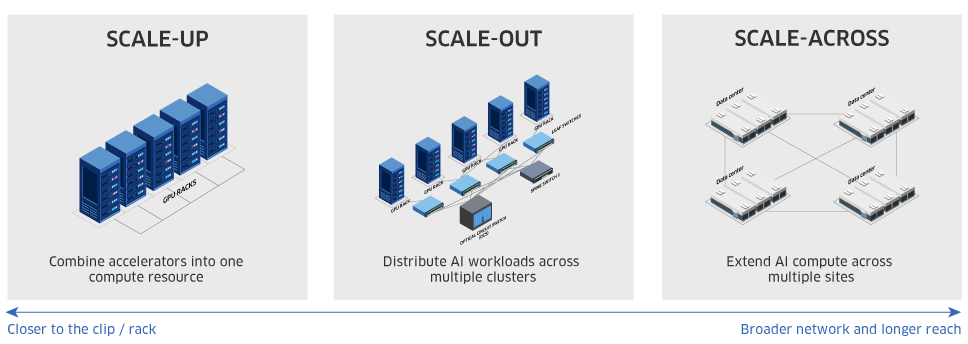
Lumentum Chief Technology Officer Matt Sysak wrote on October 30, 2026, stating that scale out connects computing between clusters, scale across connects cross site systems, and scale up addresses different challenges: connecting multiple racks to run as a coordinated computing system. As AI systems grow, these links extend from packaging or servers to boards, trays, and racks. Design must provide higher bandwidth while managing transmission distance, power consumption, heat, latency, and maintainability. The core issue is where optical connections can help maintain data flow without restricting surrounding systems.
Bandwidth density is equally important as bandwidth
The article states that the total bandwidth is only a part of the challenge. The Scale up system needs to achieve high bandwidth at the encapsulation edge while maintaining low energy consumption per bit, without increasing unacceptable latency or operational complexity. As electrical channels become faster and more numerous, signal loss, re timing, power consumption, and heat become more difficult to manage. High density packaging also leaves less space for electrical regulation and heat dissipation. System designers must decide where to place the optical engine, how to allocate bandwidth between channels, and how to maintain link reliability and maintainability. One method is to increase the total bandwidth by using more parallel optical channels with moderate speeds. This’ slow and wide ‘approach can provide high total capacity through parallel channels, while channel rates continue to evolve. The number of wavelengths, optical engine density, fiber routing, and electrical interfaces can all be adjusted according to system requirements. This is one of multiple design paths, rather than a single blueprint for all scale up architectures.
8-wavelength DWDM ELSFP and VCSEL array
At ECOC 2026, Lumentum showcased its 8-wavelength DWDM external laser small package pluggable (ELSFP) module using its InP based ultra-high power (UHP) laser platform. The optical interface design of this module meets the applicable OCI MSA requirements. In CPO and NPO architectures, external laser sources can provide light to optical engines located near computing or switching devices, while maintaining independent accessibility for easy service or replacement. DWDM supports multiple wavelengths through a compact optical interface, which helps to address bandwidth density issues in areas where packaging edge space and fiber routing are limited. Another path uses 1060nm VCSEL arrays and multimode fibers to create many parallel optical channels. At ECOC, Lumentum, Qualcomm, and Corning showcased a board level optical die to die architecture using 32 Gb/s NRZ channels. This concept validation aims to demonstrate how large-scale parallel links can support future CPO and NPO implementations. At the 2026 OCP Global Summit, Lumentum, Astera Labs, and Corning showcased fully operational PCIe over optics links in representative rack layouts. This concept validation uses multiple 32 Gb/s NRZ optical channels on multimode fiber and demonstrates an error free PCIe 5 link. The ECOC and OCP demonstrations jointly demonstrate two different applications of parallel VCSEL connections, from board level die to die link to rack level PCIe connections. They demonstrate a working architecture, while system level authentication and deployment still vary depending on the application.
Different technologies serve different system requirements
The article states that these are complementary options that serve different architectural requirements. Lumentum’s InP based continuous wave (CW) and UHP laser platforms support high-power, wavelength dense optical engines, including external laser source designs for CPO and NPO. VCSEL arrays supplement these schemes with many parallel channels on multimode fibers for short-range links, including board level and rack level applications. CPO and NPO describe the way in which the light engine is placed near the computing or switching device, while the external laser module separates the light source from the highest temperature area and can be independently maintained. Optical path switching plays a different role: it changes connections at the network architecture level. The scale up link must operate in a system that is manufacturable, monitored, maintainable, and batch verifiable. Lumentum’s InP laser product portfolio includes CW and UHP platforms, with the UHP platform already in production. Meanwhile, its VCSEL manufacturing base has shipped billions of emitters for 3D sensing applications, providing a high production foundation for different types of optical links. Lumentum also has a mature MEMS platform for optical path switching. These different manufacturing capabilities support a wide range of optical product combinations, while each new scale up application still requires its own system level certification.
Scale up will not have only one architecture
The article concludes that no single optical design can be suitable for all scale up links. The correct choice depends on distance, bandwidth density, energy consumption per bit, latency, packaging, and operational requirements. InP based CW and UHP laser sources can support wavelength dense optical engines, while VCSEL arrays provide supplementary options for highly parallel, short-range links. They collectively demonstrate how AI can rely on optical scaling: by matching each optical link with its task, from tightly coupled components to larger accelerator networks.