NEC Completes the Construction of EMCS

NEC has completed the construction of the East Micronesia Submarine Cable System (EMCS), which connects three Pacific island countries. The cable has been handed over to FSMTCC, a submarine cable operator in the Federated States of Micronesia, Bwebweriki Net Limited (BNL), a state-owned telecommunications company in Kiribati, and Cenpac Corporation, a state-owned telecommunications company in Nauru.
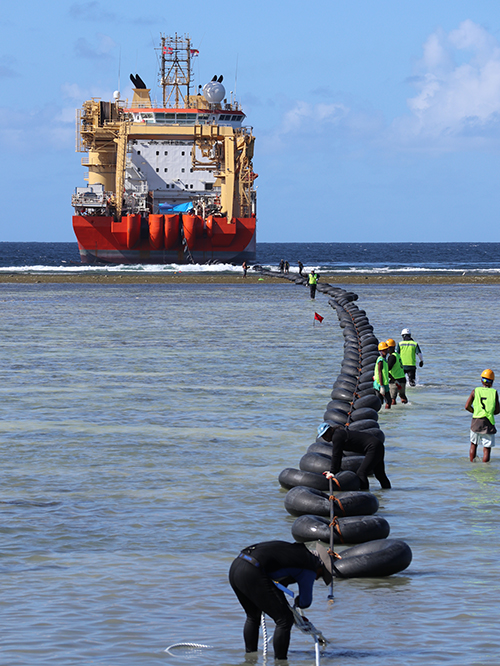
EMCS is a submarine cable with a total length of approximately 2250 kilometers, connecting three countries and four islands in the Pacific Islands region: Federated States of Micronesia, Kiribati, and Nauru. Specifically, it connects from Tarawa Island in Kiribati to Nauru Island, and then through Kosrae State in the Federated States of Micronesia to Pohnpei State.
This is the first fiber optic submarine cable connecting Kosrae State in the Federated States of Micronesia, Tarawa Island in Kiribati, and Nauru Island. Previously, telecommunications in these areas were limited to satellite communication, with issues such as communication delays and unstable connections.
EMCS will provide high-speed, high-quality and highly reliable Internet communication services, significantly improving the user experience of various online systems such as video calls and electronic payments. It will enhance residents’ daily lives and further support the economic and social development of various countries by promoting digitization.
The EMCS project has received support from the governments of Australia (through the Australian Pacific Infrastructure Facility), Japan, and the United States, and is implemented with grant funds provided by the three countries.
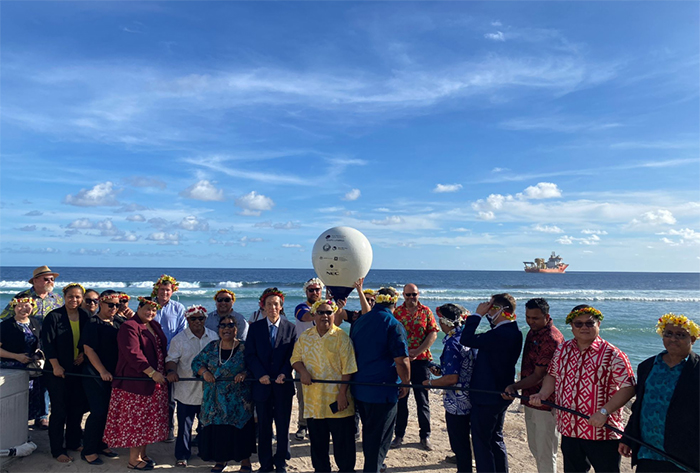
Gordon Segal, CEO of FSMTCC and Chairman of the EMCS Management Committee, stated, “Kosrae State was once the only state in the Federated States of Micronesia without submarine cable connectivity. We are glad that the construction of EMCS now provides digital connectivity to all four states of the Federated States of Micronesia. This infrastructure development not only promotes the digitization of regional economy, but also significantly improves the channels for residents to access information and services. NEC’s strong execution capability and high reliability are crucial to the success of the project, and we deeply appreciate this.”
BNL head Zikki Eoe said, “We are happy to see resilient communication infrastructure built in Kiribati and Micronesia. With the important foundation supporting regional economic digitization now in place, access to diverse information and basic services will be much better in the future. We appreciate the cooperation of the Australian, Japanese, and US governments, partner NEC, and all relevant personnel in the Pacific region.”
Zikki Eoe, President of Cenpac Corporation, said: “This project is Nauru’s first submarine cable, which enables residents to access high-speed and reliable Internet services. We highly expect that this will significantly accelerate Nauru’s future economic development and digital process. We are very happy to cooperate with the governments of Australia, Japan and the United States, as well as the Federated States of Micronesia, Kiribati and NEC to carry out this project.”
Tomonori Uematsu, Executive Director of NEC Corporation’s Submarine Network Division, said, “We are glad to have completed the construction of this new telecommunications infrastructure in the Pacific Islands region. NEC’s long-standing fiber optic submarine cable technology has helped strengthen the communication environment in the region and contributed to the realization of a safe and prosperous life. We believe this is a significant achievement. We express our deepest gratitude to all the personnel involved in this project.”