Omdia: By 2030, North American Households with Gigabit Users will Reach 60%

According to the opinion of Omdia analysts, the number of home users subscribing to gigabit broadband will increase from about one-third in 2025 to 60% in 2030, which puts pressure on Internet service providers to provide higher speeds without damaging revenue.
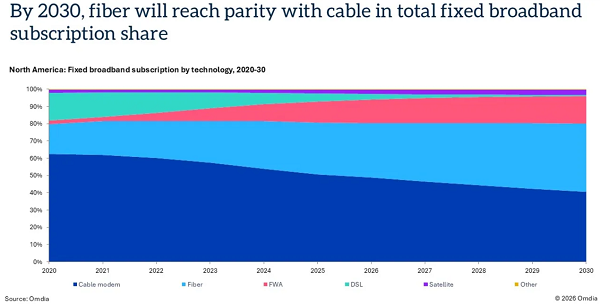
With the continuous advancement of fiber optic deployment in North America, Omdia analysts predict that by 2030, fiber optic users will reach parity with DOCSIS users based on coaxial cables, and nearly 60% of home broadband users will also subscribe to gigabit rates.
PON Market Prospects
Analysts presented their outlook at a webinar hosted by the Fiber Broadband Association last week. According to Jaimie Lenderman, research manager at Omdia, PON remains the driving force behind fiber to the home deployment in North America. It is expected that by 2031, the compound annual growth rate of optical line terminals (OLTs) will be 14.3% (approximately 1.7 million ports per year), and the compound annual growth rate of optical network terminals (ONTs) and optical network units (ONUs) will be 6.6% (approximately 12 million ports per year). (Omdia and Light Reading are both under the umbrella of Informa TechTarget.)
Lenderman pointed out that although PON shipments are still on a growth track until 2031, there will be a slight decline in 2025, “partly due to operator inventory consumption, but also partly due to macroeconomic and geopolitical factors.” She added, “We do expect the market to maintain healthy year-on-year growth in the future
However, these predictions may change as the demand for fiber optic in the BEAD project competes with the need for large-scale enterprises to build AI data centers – a situation that is reportedly leading to skyrocketing fiber optic costs and delivery times. Lenderman admitted, “There may be a situation of supply chain tension, which will prolong our forecast cycle.”
The rise of gigabit users
Lenderman stated that currently 10G PON accounts for 59% of operator PON ONT/OLT shipments, but by 2031, 10G PON and higher technologies will occupy the “vast majority of the market share” -93%. She added that out of this 93%, about 4% will use 25G PON and 50G PON, mainly driven by “heavy users” and non residential applications.
In terms of consumer services, Alzbeta Fellenbaum, the business leader of Omdia’s focus on service providers, stated that there is a “demand for gigabit speeds”. Fellenbaum stated that Omdia predicts that by 2030, nearly 60% of household users will subscribe to gigabit or higher speed services, up from about one-third in 2025.
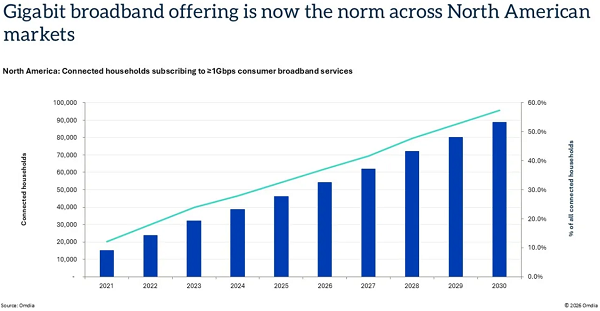
Fellenbaum said, “Gigabit services have become the new mainstream, and we are gradually seeing operators and service providers moving towards higher levels, providing increasingly higher speeds.”
However, she added that there is a risk for service providers to increase user speed without profiting from this improvement, thus “facing the risk of revenue and ARPU damage in the future”. It is worth noting that Fellenbaum stated that the US and Canadian markets are “quite resistant to this trend,” but this risk still exists in other global markets.
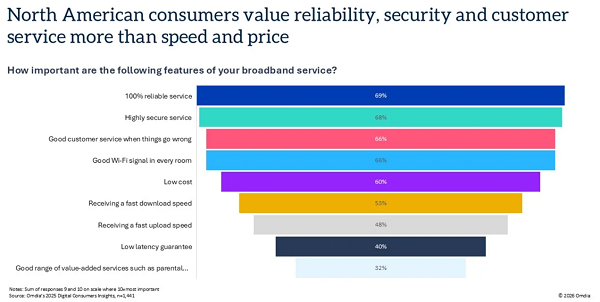
Fellenbaum said that one way to solve this problem is to extract value from other service elements that consumers value. According to Omdia’s survey data, “What really matters are reliability, safety, and customer service,” she said. “Consumers value these aspects more than speed and price.”
As an example, Fellenbaum mentioned AT&T, which offers basic, mid-range, and premium service packages based on speed, while also profiting from additional services, “whether it’s advanced network security products, advanced Wi Fi and mesh systems, or advanced technical support,” she said.
Will fixed wireless access decline?
When answering Gary Bolton, CEO of the Fiber Broadband Association, about the future of fixed wireless access (FWA) and whether we will see the “fixed wireless access foam burst” at some time, Lenderman pointed out that the image of FWA users “is often slightly different from ordinary fiber users”, and FWA usually attracts users who do not like to sign contracts or want to add additional services to their mobile packages.
However, both Lenderman and Fellenbaum stated that they expect FWA growth to stabilize in the coming years as fiber optics become more widespread and AI demands higher speeds and bandwidth. When it comes to FWA subscription volume, Fellenbaum said, “You can see from our fixed broadband chart that it will continue to grow in the coming years, but by 2030, the growth will have basically stopped.”