STL and Corning Explain Multicore Fiber and Its Importance for Data Centers

The standardization of single-core fiber has spanned 20 years, while multicore fiber incorporates four cores within the same cladding. The latest fiber-optic technology is multi-core fiber, which integrates four cores into a single fiber. This technology is significant because it reduces the size of optical cables in data centers. Multicore fiber delivers fourfold capacity but does not incur fourfold costs.
The manufacturing process of optical fiber glass is quite fascinating: optical engineers design the glass by creating a thick glass rod called a fiber preform, which is essentially a giant version of the final hair-thin optical fiber. At the center of the preform is the core, surrounded by the cladding. Together, they contain all the engineered properties of the optical fiber. The preform is then placed at the top of a towering drawing tower (ranging in height from 30 to 65 feet) and heated to approximately 2,000 degrees Celsius. This allows a fine strand to be drawn downward, forming the optical fiber.
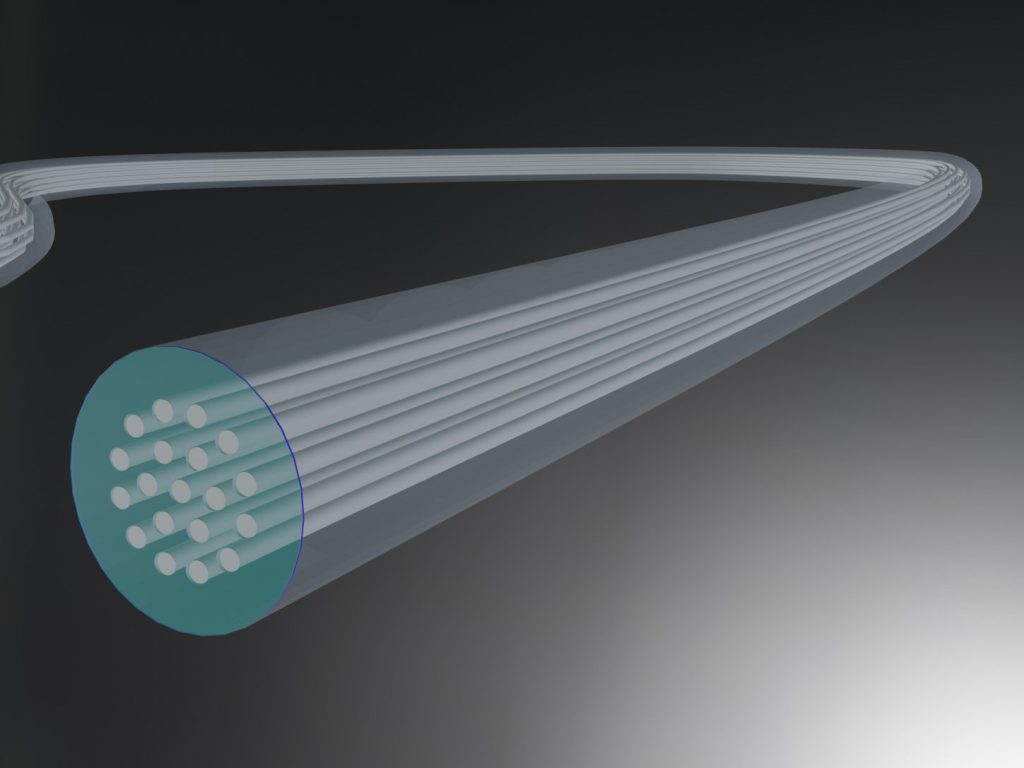
To facilitate demonstration, fiber optic manufacturers can cut preforms into cross-sections to showcase the core. At this week’s Optical Fiber Communication Conference (OFC), Fierce observed one such cross-section at Corning’s exhibit booth.
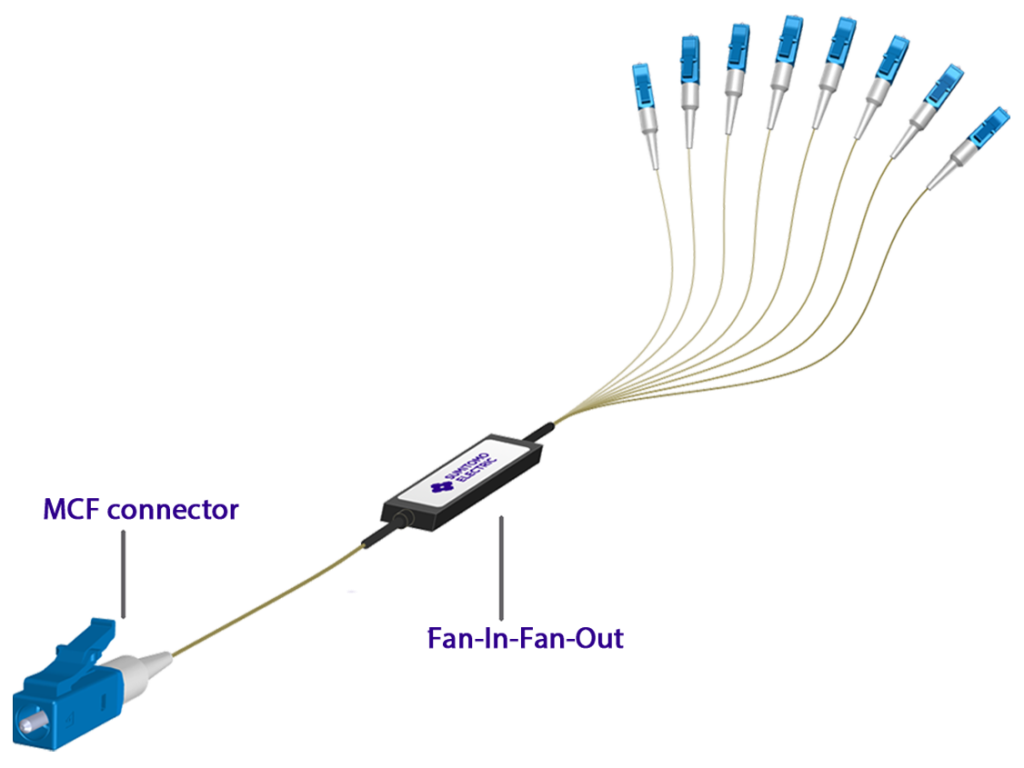
In recent years, the technology in the optical fiber industry has evolved from single-core fibers to multi-core fibers. This means that each fiber contains multiple cores within a single cladding, with each core capable of carrying independent optical signals, enabling parallel data transmission within the same fiber.
The industry has determined that the four-fiber core is the optimal ratio for multi-core fibers (rather than two or three cores), and efforts are underway to standardize four-core fibers.
STL also participated in this week’s OFC conference, conducting research on multicore fibers. Badri Gomatam, Chief Technology Officer of STL’s telecommunications division, stated, “Our goal is to advance it from the early stages to standardized production.”
An STL executive serves as the vice president of the International Telecommunication Union, an organization under the United Nations responsible for setting global standards. Gomatam noted that single-core fiber has been standardized for 20 years, while multi-core fiber merely replicates standardized components precisely four times. The only difference lies in the fact that these four fiber cores are housed within the same cladding.
“Currently, the cost and performance have reached the optimal balance point,” he said. “It offers four times the capacity, but the price is not four times higher.”
When it comes to capacity and cost, this week’s OFC exhibition indeed had a clear theme. Everyone in the fiber optics industry seems to be pursuing four goals: higher density, smaller space, lower cost, and reduced power consumption.
Fierce asked whether increasing density and reducing space occupancy are so crucial that we need to shrink the size of these hair-thin optical fibers.
To address this question, Gomatam displayed a typical fiber optic cable used inside data centers—containing 6,912 fibers. This cable is unexpectedly large and heavy. A single rack in a data center may require up to six such cables for connections.
STL’s CEO Rahul Puri stated, “Ultimately, it all comes down to space.”
STL has collaborated with Colt Technologies to conduct a multi-core fiber pilot. The trial was conducted within the London metropolitan area network, connecting two Colt access points (PoPs) with coverage distances of 9 kilometers and 63 kilometers, respectively.
Puri stated that multicore fiber technology “will take some time to be widely adopted.” However, the progress in the optical communications industry is much faster than in the past (thanks to the advancements in large-scale computing!).
“Traditionally, this could take a decade, but I believe this year is a milestone for multicore fiber,” Gomatam said.